Monday, 10 February 2014

Performance at the Private view of Salon Hysterique: Gabriella Daris and Diana Pornoterrorista


During the private view of the exhibition La Petit Mort et la Grand Hysterie on Tuesday 21st January 2014 I saw the performance Cadaver Exquis: A Parlour Game, a collaboration between Gabriella Daris and Diana Pornoterrorista. What follows is Gabriella Daris' text on the piece.

CADAVRE EXQUIS: A PARLOUR GAME: LE SPECTACLE
A parlour game played with the cut-up technique - an exquisite corpse between the White Swan/Odette/Juliette and the Black Swan/Odile/Justine. Under the veil, the corpus is stimulated by ways of poetic imagination and body memory recollection, through the operation from concealment to revelation to concealment till they reach, the end. Do you think it is easy to get rid of a wound, to shut the mouth of a wound?[© Text copyright: Gabriella Daris, 2013]
LES POETS CORPOREL | LES SALONINNIERES
White Swan/Odette/Juliette: Gabriella DarisBlack Swan/Odile/Justine: Diana Pornoterrorista

The performance involved two figures dressed in a black and a white burkha, representing a duality like white/black swan personifications, they will later reveal that they are naked underneath the garments, wearing white feathers around her long neck-Gabriella Daris- and a black feather mask, almost like a beard, surrounding her mouth-Diana Pornoterrorista.

The piece commences with Daris sitting, and the audience is asked by 'Odette' to cut pieces from her white burkah, with a pair of scissors, revisiting Yoko Ono's 1964 Cut Piece. We are asked to write on the white piece of fabric something that, based on our personal experience, is a prison for us. After a long time, when 'Odile' has barely any fabric covering her, Diana asks a member of the public to read out a text, while she collects the written bits of fabric from the audience, showing them to us, one by one, stapling them onto her flesh with a staple gun. From what I can recall, the text is a criticism to Western perspectives on the burkah, encouraging to turn 'our' (Western) critical (and prejudist) view onto our own issues, to stop criticising other cultures to look at our own, and the way in which we classify and label people to perpetuate forms of oppression.

The text is reflected in most of the words on the fabric, which have come to represent 'prisons' for their bearers, recalling a lot of insults and labels. Once the black swan is semi-covered once more by the shameful words, the white swan helps her take them off, one by one, and they are swallowed between the black feathered mouth, devoured, like an aggressive vengeful act. Each word is shown to the audience at a time before disappearing inside her mouth, and when Odile/Diana comes across one in particular, 'capitalism', she turns around and puts it up her ass, literally-in a physical metaphor.

The two characters, the white and the black burkahs, swans, with their emphasis on being a pair and somehow opposites and complementary, speaks to me of the way difference is constructed in society, in opposing pairs: female/male, homosexuality/heterosexuality, healthy/pathological, fat/thin, able/disable, black/white, strong/weak, self/other...etc. During the performance, the two artists don't function as opposites, but more as a pair working towards the same goal, revealing the body, covering it with the words-prisons- of many others, in a ritual where they are finally devoured and consumed.

Beyond, or underneath, the burkah, their nude female bodies are diverse, Diana's 'femenine' curves defied by her embodied rejection of gender stereotypes (in general in her practice as an artist), Gabriella's shows the signs of discipline and training from her formation as a classical dancer. Notions of active/passive are also explored, the two women shifting positions, Gabriella receiving the audiences cuts, cuts that become empowered in the transformation from cuts to words and from words to Diana's affirming action of self-stapling.

These are two bodies that have obvious presence in the work, from the moment they come to view and in the actions revolve around them: covering and revealing of them, cutting closely around, stapling on. The appearance of the wound in Gabriella's text, together with the concept of prison, as understood by the diversity of the personal audience's experiences, makes use of the burkah as a metaphor for the skin-as-prison, the site to reclaim the flesh in affirmative action, to define as individuals in all our diversity what it means. Perhaps the skin is the Westerner's (not only female) prison, far more subtle and engrained than any garment. Can wounds function beyond signs of abuse? Self-inflicted in affirmative creative action they defy passive/active assumptions of cutter and receiver, inflictor and victim. 

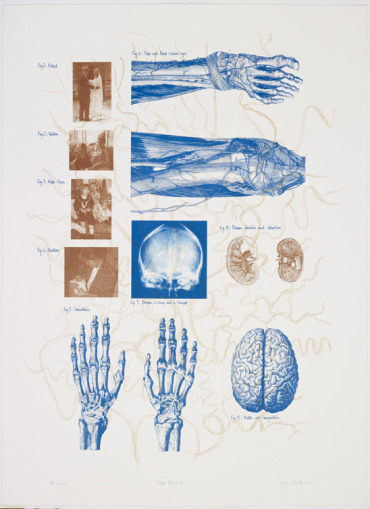
The wound is a core concept in my practice, as can be seen on two of the prints I contributed to the show, The Anatomy of the Hidden Vagina and Incredulity. These together with the work of many other artists, Lizzie Learman amongst them, is still on show until the 19th April, at Blacks, 67 Dean Street, W1D 4QH London.


 The Anatomy of the Hidden Vagina and Incredulity.

 
Lizzie Learman's Trouble and Strife


Sunday, 12 January 2014

La Petit Mort et la Grand Hysterie


I will be exhibiting some of my prints at La Petit Mort et la Grand Hysterie, a fascinating curatorial project by Gabriella Daris, that is composed of the exhibition, a duet performance, and the launch of Hysteria feminist magazine. I am thrilled to take part! The group show will be open from the 22nd January to the 19th April, Monday to Saturday, 10am to 1pm, in Blacks, 76 Dean Street, W1D 4QH.
 
Amongst my work in the exhibition you will be able to find The Anatomy of the Hidden Vagina (pictured above), and will also find darkly humorous pieces by Lizzie Learman, and works by emerging and established artists including Annie Sprinkle and ORLAN.


Saturday, 4 January 2014

Cierra la Boca, Nota de Prensa


 Congreso de los Diputados, Madrid, 26 de Diciembre, 2013. Duración: 1hora y 45 minutos. 


Ministerio de Justicia, Madrid, 28 de Diciembre 2013. Duración: 1hora y 45 minutos. 


Plaza de Sol, Madrid, 29 de Diciembre 2013. Duración: 2horas

Las tres acciones que he realizado en la calle surgen a partir de un cúmulo de cosas. Soy Julia, una artista
española de 28 años que estudia y trabaja en Londres, mi obra se centra en el cuerpo, y hago grabado y performance. Cuando leí una mención en un periódico británico (The Guardian, 20 de Octubre, 2013) sobre la huelga de hambre de Jorge Arzuaga, cuando llevaba 4 días, la noticia me impactó mucho. Cuando fui a Madrid en Noviembre fui a verle, ya llevaba más de 20 días. Había algunas personas más con él que se habían unido a la huelga y carteles donde exponían sus motivos, como la corrupción, las mentiras, los recortes en sanidad y educación…  Jorge, en particular, pedía la dimisión del gobierno. Su acción me hizo reflexionar mucho, pensé que tenía que hacer algo al respecto. El hecho de que en mi país alguien llegase al extremo de dejar de comer me dejó marcada y me hizo sentir que sólo nos quedaba nuestro cuerpo para protestar de manera eficaz. Que la frustración y la indignación habían llegado a un límite inaceptable, como para que una persona concienciada socialmente y coherente hubiese decidido iniciar una huelga de hambre.

Como artista, mi trabajo se centra en el cuerpo, y por eso las tres performances de estos días (26, 28 y 29 de Diciembre 2013) tienen en común el cuerpo como territorio donde poder expresar preocupaciones políticas. He llamado al conjunto «Cierra la Boca», porque utilizo la boca para hablar de censura y de voz. Sin embargo, no utilizo mi voz, no tengo un discurso político hablado sino que pretendo utilizar el cuerpo para sugerir ideas; la diferencia fundamental es que el cuerpo en la performance evoca, pero no tiene una lectura única. A mi parecer, ésa es la clave por la que la acción de Jorge Arzuaga nos ha llega tanto a muchos, porque a veces nos perdemos en la diversidad de discursos y opiniones, y olvidamos la base humana o social que nos une. Con mi cuerpo trato de encontrar lo que es importante para mí y generar un debate que creo es importante para todos.

Nunca había realizado performances en la calle hasta ahora, por lo que la del 26 de diciembre delante del Congreso de los Diputados, ha sido mi primera experiencia. Esta performance la he llevado acabo en relación directa a la Ley de Seguridad Ciudadana, que me hace sentir vulnerable, que siento que atenta contra el derecho básico de toda persona a expresarse en la sociedad. Estuve 1 hora y 45 minutos inmóvil, de rodillas, con los ojos cerrados, los puños cruzados a la espalda y los labios sellados. De esta experiencia me llevo todo lo que no ví, todo lo que escuché decir a la gente que pasaba, y las sensaciones como el frío, el dolor de músculos, el cansancio y las dudas. Pero sobre todo lo que ahora no puedo decir, el estar. El hacer algo con lo que me encuentro acorde. Algo que define un poco más lo que soy o lo que quiero ser; algo que no va a cambiar el mundo, pero que articula mi posición ante él.

La performance del día 28 de Diciembre delante del Ministerio de Justicia, está motivada por la reforma de la ley del aborto. Considero inaceptable que me quiten el derecho a decidir sobre mi propio cuerpo, que es lo mismo que mi persona. Los órganos reproductivos, el ciclo menstrual, la menstruación, la ovulación, los cambios hormonales, no son algo que me pertenezca, no son sucesos de mi cuerpo desvinculado, es algo que forma parte de mi persona. El tener un hijo, el engendrar vida dentro de mi ser, no es algo que se pueda desvincular de mí como individuo. Por tanto el aborto es un derecho de la persona, que en este caso resulta ser mujer.

La reforma que propone el ministro Gallardón equiparará la ley a la de 1985, y sólo puedo comprender este retroceso desde una ideología marcadamente religiosa acorde a esa época, que es totalmente inaceptable en un país definido por la Constitución como no confesional.

La performance del día 29 de diciembre a las 16:00 tiene relación con la huelga de hambre de 41 días de Jorge Arzuaga. Mi intención: dar visibilidad y tratar el tema de la censura y de la autocensura. Considero totalmente inaceptable que una persona esté en huelga de hambre tanto tiempo y no salga en los medios de comunicación.

He llegado a un punto en el que no hacer nada, más que nunca, es tomar una posición política que no puedo aceptar. No puedo permitirme el lujo de criticar lo que otros hacen desde una posición pasiva, puesto que es lo mismo que apoyarles.

Vivo en Londres, donde estudio y trabajo, y cada vez que vengo a España me duele ver la situación que estamos viviendo. Me preocupa mucho cómo nos alejamos de la democracia para entrar en un terreno gris donde los dirigentes actúan sin responsabilidad, sin escuchar ni al pueblo ni a nadie, sin dar cuenta ni explicaciones de nada, cambiando leyes haciendo abuso de su mayoría en el parlamento, o lo que es lo mismo, abusando del sistema democrático para acercarse peligrosamente a un modelo de dictadura, caracterizado por un incremento en la manipulación y censura en los medios, y un incremento de las medidas represivas y de «orden público».

La manipulación de los medios también me preocupa profundamente porque censuraron la huelga de hambre de Jorge Arzuaga y tienden a una criminalización de las personas que protestan, asociándolas a grupos e ideologías particulares; se tapa la diversidad de la masa que protesta, mucho más cercana a la mayoría, que «la mayoría» con la que el gobierno pervierte la democracia.

Friday, 3 January 2014

Cierra la Boca/Shut your Mouth

 
Cierra la Boca (Shut your Mouth) is a series of three performances done in Madrid, in response to Spain's social and political situation, addressed in three specific problems: the Public Safety Law (26th December), the Abortion Law (28th December) and Jorge Arzuaga's hunger strike and its invisibility in the media (29th December).
 
In these performances I am not only an artist, but also more overtly my identity as a Spanish person and a citizen is underlined. They respond to artistic, as well as personal and political concerns.  
 
I have chosen to use the body in performance to address these particular issues because of the body's potential as a political terrain. The body can become the advocate of the person, and a medium to represent oppression.
 
Taking cultural psychiatrist Armando Favazza's concept of skin as the limit of the self, the whole surface of the body could be imbued with symbolic power as the frontier between self and world, and hence be a privileged site to explore the individual's relationship to the social and political. I choose the skin as the place to negotiate and contest power, a plastic material with it's natural and artificial openings that expose the vulnerable self inside. 


Top two images from Cierra la Boca, bottom from Occult (2011) performance.


The mouth plays a central role in the three pieces. What comes out of it, what goes in, together with it's association to speech, voice, silence and censorship, bring all the pieces together. In reference to Jorge Arzuaga's hunger strike, the mouth is wide open to show it's emptiness, the biological functionality of food intake denied for political reasons; in relation to abortion law, the mouth becomes uterus, and by extension the menstrual cycle becomes infused with personhood; at the Congress performance, the mouth and eyes are sealed and silenced.

Cierra la Boca consists of three performances I did in Madrid:

- 26th December 2013 at the Congress of Deputees, in response to the Public Safety Law.
- 28th December 2013 at the Ministry of Justice, in response to the Abortion Law reform.
- 29th December 2013 at the Plaza del Sol, in response to Jorge Arzuaga's hunger strike.

There is also a press release in Spanish.


Monday, 30 December 2013

(3 of 3) Cierra la Boca/Shut your Mouth: performance in Sol

This performance is part of a series of three performances titled Cierra la Boca (Shut your Mouth), that I did in Madrid during the 26th, 28th and 29th of December 2013.


29/12/2013, 16:00 Puerta del Sol, Madrid. Duration: 2 hours.

This was the last of the three performances on the street. My intention was to give visibility to the hunger strike initiated by Jorge Arzuaga on the 12 of October 2013, which lasted 41 days. Other people such as Gisela, Alex, Frank and Juanma joined the strike, each with their own reasons, all sharing a wish to protest against the government. Signs around them exposed their inconformity with corruption, cuts and privatization of public healthcare and education, breaching of election promises, evictions, reduction of state pensions, unemployment and labour instability, bank and Church privileges, sexism, hunger and poverty.

I wanted to represent the 41 days using my body as a reflection of theirs, using time and repetition in an attempt to convey the weight of their action. The lack of visibility in the media was a major concern, and this situation was largely what prompted me to do the series of performances in Madrid.

I draw the digestive system on my skin, from the corners of my mouth to the rectum. Then I open my mouth and turn to look at the audience all around me, then I close it and swallow, sealing my lips with tape. I have closed my eyes and remain still for a period of time. Then I open my eyes and take the tape off. I open my mouth again, to start once again, representing the act of not eating, 41 times. Each time I take the tape off and open my mouth, I am counting a day of the hunger strike and making a mark on my arms; I say: "Day number .... Jorge Arzuaga was 41 days on hunger strike here." At the end of the 41 times, I remove the latex from my abdomen and leave it on the ground.

Saturday, 28 December 2013

(2 of 3) Cierra la Boca/Shut your Mouth: performance at the Ministry of Justice


This performance is part of a series of three performances titled Cierra la Boca (Shut your Mouth), that I did in Madrid during the 26th, 28th and 29th of December 2013.


28/12/2013, 16:00 Ministry of Justice, Madrid. Duration: 1hour and 45 minutes.

I did this performance as a response to the change in the law regarding abortion in Spain, which the Minister of Justice Alberto Ruiz-Gallardon wants to put through. The current law follows a model of stages, by which women can choose to have an abortion during the first 14 weeks of pregnancy. The reform proposed by Gallardon is equivalent to the abortion law from 1985, whereby women will not be able to voluntarily interrumpt pregnancy, with the exception of cases of rape, serious health risks, and some cases of foetal malformation.   

I draw a uterus on my abdomen with lipstick, then proceed to paint my lips with it, together with the palms of my hands. I go over my lips, one at a time, with my finger, to then draw an opening over the uterus, drawing a similarity between my mouth and the vaginal opening. After this, I extract a lump of red wax from my mouth, and shape it in the form of a foetus, only to re-shape it into a ball and put it back into my mouth. Then I smudge my lipstick across my face and seal my mouth with black tape. After a long pause, I take the cross off my lips and place it on the ground before me. I repeat the action with the wax and tape 28 times, building a menstrual calendar on the floor.

My intention with this performance is to construct an image of the female body as active in the process of creation (reproduction). In my view, the experience of the menstrual cycle is not something that 'happens' to the body, it is something that forms part of my personhood. Making babies, literally, out of wax, with my own hands, and then returning them to the inside of my body, is my way of performing the menstrual cycle, to propose an understanding of the body and its processes undetached from the condition of being an individual. In this context, the interruption of pregnancy is a right of the individual, which happens to be female.

Drawing the comparison between the uterus and the mouth allowed me to explore the notion of freedom of choice versus oppression in direct relation to reproduction.


Thursday, 26 December 2013

(1 of 3) Cierra la Boca/Shut your Mouth: performance at the Congress

This performance is part of a series of three performances titled Cierra la Boca (Shut your Mouth), that I did in Madrid during the 26th, 28th and 29th of December 2013.


26/12/2013, 16:00 Congreso de los Diputados/Spanish Congress of Deputees, Madrid.

For 1 hour and 45 minutes I stand immobile in the same position, kneeling, wrists crossed behind my back, eyes shut, lips sealed. In reference to the Public Safety Act the government wants to put through by which fines for protesting in places of political significance such as the Congress increase to up to 600 000 euros, and photographing and filming police agents also constitutes a serious offence.

Durante 1 hora y 45 minutos permanezco inmovil en la misma posicion, arrodillada, los brazos atras cruzados los puños, ojos cerrados, boca firmemente sellada. En referencia a la Ley de Seguridad Ciudadana.


Reportaje sobre la performance en periodismodigno http://www.periodismodigno.org/cierra-la-boca-performance-frente-al-congreso-contra-la-ley-mordaza/

An article about the Public Safety Law in english http://digitaljournal.com/article/362430

Wednesday, 19 June 2013

David M. Cook

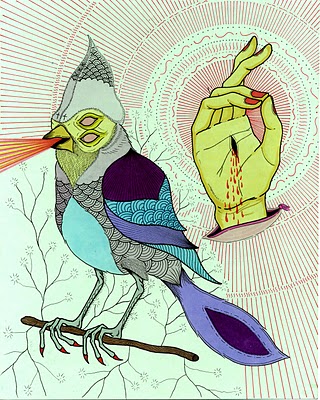
I really enjoy the graphic-tattooesque language of David M. Cook, especially on this piece that touches on religious iconography of the wound. 


Talking of his recent bird series: “I find the birds living in a new world of pattern and color, and they have taken on more religious iconography (another reappearing theme in my work) with the idea of killing dreams - The priests and bishops of this world trying to hold back the thoughts and ideas of the non-believers of their world, using mind-control, and often times death, to make their point.” David Cook.
 
The stigmatized hand in the background of this image is coming out of an open slit, which, judging by it's clitorial protuberance, is very much a vagina. I love the two small crosses on the bird's head, and the aureola type pattern emanating from the hand.


Tuesday, 18 June 2013

Witchcraft and Dissection


I went to a talk today titled Dissection and Witchcraft: Images of Corpses in Early Modern Art, by Constanza Isaza Martinez, which was based on her MA dissertation (History of Art, Courtauld Institute), at the Last Tuesday Society, part of a series of lectures organised by Morbid Anatomy.

Last time I heard about the Last Tuesday Society was admiring a beautifully crafted flyer for one of their famous parties, and besides throwing unique quirky parties, they are an organisation "devoted to exploring and furthering the esoteric, literary and artistic aspects of life in London and beyond", and they have the most amazing taxidermy-fanatic shop (11 Mare Street).

I have also come across Morbid Anatomy before, a blog and library based in Brooklyn, New York, who exist to survey 'the interstices of art and medicine, death and culture'. Sharing their love for skeletons, and corpses across the animal kingdom, these two uncanny venues have come together to delight us with a series of lectures and workshops throughout June and July, check their websites for more info.

So there I was, in the back room of the shop, still recovering from marvellous and monstrous sights such as a two-headed bat, a monkey-mermaid and a winged rodent.

Constanza's lecture was unique and fascinating in combining two realms that share a predilection for the body: witchcraft and anatomy. She discussed ways in which both the anatomist and the witch use the body, body parts and fluids, to exert their power. Similarly, they access the insides to search for ointments, particular organs or excretions to create their concoctions. Yet their status and representation could not be furthest apart, precisely because anatomists wanted to disassociate themselves from any occult practices, and wanted to present their practice as a new mission exclusively driven by the discovery of knowledge and truth, and completely unrelated to morbid curiosity.

All this talk was illustrated by historical prints of witches and anatomical illustrations, including the work of Vesalius and Alfred Durer and Hans Baldung. I truly enjoyed the lecture, which I found touched on a matter that has not been researched enough, and which my own research is concerned with.

Witches in a Cellar, Jacob de Gheyn II.

Sunday, 16 June 2013

Zero: Embodying the Blues

Earlier this month I went to see Zero, a performance by Clod Ensemble fusing dance, visual theatre and live music. The trailer reminded me somehow of the intro for the series True Blood. (Georges Bataille's dream series.)


It was all about the music, and the performers where dressed in suits and evening dresses, emphasising gender roles, swapping them, sometimes. The live music seemed to infuse the bodies of the dancers, to follow more scripted dances, contort like predating animals, act scenes of a silent play or become characters of human tragedy. A voice in the background which I placed in between a police interrogation and an American talk show, provided snapshots of deeply personal stories, of loss, suffering and love.

Perhaps there is a link between vampires, blues and human tragedy. Perhaps it's through tragedy that our animal instincts take over and bring chaos to ordered life, when men and women, dressed acceptably to go to church, can overlook civilised norms to crawl and bite. Some of the moves, some of the scenes in Zero, also reminded me of Riccardo Buscarini's Athletes, when there is silence, and a group of individuals exchange gazes that tell a whole story that we know nothing about. And sometimes they move together, others they isolate one, creating a prey.

Susan Aldworth: Printmaking and Anatomy in the search for Self


Susan Aldworth's work is currently on show at the National Portrait Gallery, until the 1st of September 2013. I am interested in her work because she works primarily with printmaking processes, the 3 pieces on show being portraits consisting of 9 monotypes; and with medical imagery, in this case with historical and modern scans of the human body. The sitters are people with epilepsy, a condition that links with the artists' search for ways to visualise the self. She has worked before with people with Alzheimer and Schizophrenia, and her current practice focuses on the gap between the physical materiality of the brain, and the interior sense of subjectivity.

My favourite piece is Elizabeth, 2012, whom Susan portrayed with an image of her face located in her lower abdomen, due to the woman's deep concerns about having a baby. A very interesting move, changing the commonly accepted seat of identity from the brain to the uterus. Elizabeth refused to take the drugs that controlled her epileptic attacks due to their impact on pregnancy, and with this risked her life. One could say thus, that her strong yearning for being a mother is effectively reflected in the portrait, where her face, her identity, lies within her womb.


I attended In Conversation: The Portrait Anatomised, on the 6th of June 2013, where a neuropsychologist, the artist, and Max (one of the sitters) came together. Most of the conversation turned around the difficulties of grasping the self, and the gap between the physical brain and consciousness. Susan's use of medical imagery is a turn in comparison to the tradition of portraiture hosted at the gallery, medicine portrays the inside in a literal and 'truthful' way. Furthermore, medical imaging captures a fragment and perhaps depicts a more suiting vision of a changing, fractured and elusive self? In comparison to traditional portraiture that seems to idealise subjectivity, elevating it to the status of 'essence', immutable and immortalized in the process of representation, almost assuming the existence of the soul.

I described medical images as 'truthful' because I think this notion of verisimilitude is problematic, the self is something we have a sense of, but that by definition cannot be seen, therefore what we see in medical images is not it, but it's as close as we can get to having a visual token of what it's like, where it inhabits. Following scientific discourse, we are not used to believing in things that we cannot see, we deem they do not exist, thinking that the other alternative, the soul, lies in the realm of religion. However, just because science cannot provide us an image of it, it does not mean the self does not exist, and it does not mean it is necessarily the soul.

We exist in the minds of others that know us (who know more of, or differently, about us than we do), and our unconscious also exists, the even more elusive version of our subjectivity. We are too used to equating seeing with believing, to equating what we think with what we are, and to looking for the truth by removing the skin, as if it stood for the fake appearance concealing the ultimate reality. We learned the story of the Incredulity of St Thomas all too well, and forgot it was a story.

 The Incredulity of St Thomas, Caravaggio.
 
 
These are two lithographs from 2012 by Susan Aldworth, were she explores anatomically unorthodox representations of the body:
 
 Nature Nurture 2
 
 Reassembling the Self 4
 
 
Also on show now is Transience, a solo exhibition of Susan Alworth's work at the GV art Gallery, which I am looking forward to visiting.

Anatomical Wax Works

Eleanor Crook is a wax model artist that has done work for medical museums such as the Gordon Museum of Pathology and the Royal College of Surgeons, has a background in sculpture and fine art (Central Saint Martins and Royal Academy) and whose practice bridges art and science, using the fascinating technique of wax modelling. I would like to show images of a recent piece titled Death Seals Our Long Work of Thoughts, and a video in which we can see her working on a pathological model:


(Two images above) Death Seals Our Long Work of Thoughts, Eleanor Crook, 2013


She's quite unique in her specialisation, involvement with museums, as well as producing work of what would fall under an artistic nature. I find it very interesting how the materials and technique she has chosen to master, have beautifully inscribed her in the history of anatomical model making, linking her work to La Specola's museum specimens, for instance, the classic 18th century Italian models, which she even mentions in the video as an important influence.
 
And how a technique -wax modelling- having it's own cultural history, connotations, particular aesthetic and technical nature, can be further developed by a contemporary artist, employing this charged language to produce works that are relevant today, yet acknowledge our cultural history.
 
I guess this is how I feel about printmaking too, possessing intrinsic meaning, that I strive to discover and unleash, finding a logical and creative marriage between form and content.
 
Prosopology of the Dead, Eleanor Crook.
 
 
Prosopology of Death, is another piece by Eleanor Crook refering to death, and what I find so successful is the fact that the technique speaks of death too, so she uses this language to her advantage in shaping her ideas. Wax refers to death in many ways, from the anatomical models of disease, to it's use in death masks, and it's physical similarity to skin, which has made it a preferred material for realistic life-like representations of the body throughout history-which inevitably remind us of corpses. Following this trail of thought, go to an earlier post I did on wax


Friday, 14 June 2013

Tattooed Saints and Religious Anatomies

I absolutely revere Ramon Maiden's work, an artist from Barcelona; the more I see the more connections I find with my own art and interests.
I came across his work at a tattoo parlour in East London, his religious figures. Then I saw his references to anatomy, and his work on wooden hands.


Tattoos, anatomy and religion, what a great mix. I like his emphasis on the wounds of martyrs, and the treatment he gives to skin, engraving representation on top of representation, creating layers of iconography on top of the body. There is the 'real' body, the image of the body, and Ramon Maiden embellishing a further layer of meaning. The reference to anatomy is very effective as the skin serves as a great metaphor for the process of representation, as if this was the 'image' we present of our true selves (our insides). A socially acceptable, gendered, hermetic, leather vessel that contains and conceals what we 'really' are: a mess of fat, blood and guts.