Showing posts with label I like.... Show all posts

Wednesday, 19 June 2013

David M. Cook

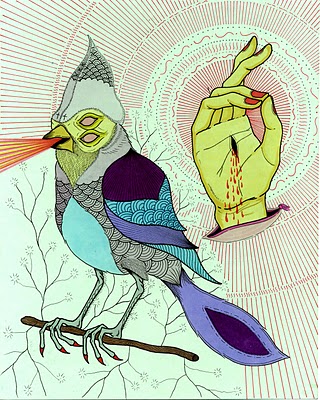
I really enjoy the graphic-tattooesque language of David M. Cook, especially on this piece that touches on religious iconography of the wound. 


Talking of his recent bird series: “I find the birds living in a new world of pattern and color, and they have taken on more religious iconography (another reappearing theme in my work) with the idea of killing dreams - The priests and bishops of this world trying to hold back the thoughts and ideas of the non-believers of their world, using mind-control, and often times death, to make their point.” David Cook.
 
The stigmatized hand in the background of this image is coming out of an open slit, which, judging by it's clitorial protuberance, is very much a vagina. I love the two small crosses on the bird's head, and the aureola type pattern emanating from the hand.


Sunday, 16 June 2013

Anatomical Wax Works

Eleanor Crook is a wax model artist that has done work for medical museums such as the Gordon Museum of Pathology and the Royal College of Surgeons, has a background in sculpture and fine art (Central Saint Martins and Royal Academy) and whose practice bridges art and science, using the fascinating technique of wax modelling. I would like to show images of a recent piece titled Death Seals Our Long Work of Thoughts, and a video in which we can see her working on a pathological model:


(Two images above) Death Seals Our Long Work of Thoughts, Eleanor Crook, 2013


She's quite unique in her specialisation, involvement with museums, as well as producing work of what would fall under an artistic nature. I find it very interesting how the materials and technique she has chosen to master, have beautifully inscribed her in the history of anatomical model making, linking her work to La Specola's museum specimens, for instance, the classic 18th century Italian models, which she even mentions in the video as an important influence.
 
And how a technique -wax modelling- having it's own cultural history, connotations, particular aesthetic and technical nature, can be further developed by a contemporary artist, employing this charged language to produce works that are relevant today, yet acknowledge our cultural history.
 
I guess this is how I feel about printmaking too, possessing intrinsic meaning, that I strive to discover and unleash, finding a logical and creative marriage between form and content.
 
Prosopology of the Dead, Eleanor Crook.
 
 
Prosopology of Death, is another piece by Eleanor Crook refering to death, and what I find so successful is the fact that the technique speaks of death too, so she uses this language to her advantage in shaping her ideas. Wax refers to death in many ways, from the anatomical models of disease, to it's use in death masks, and it's physical similarity to skin, which has made it a preferred material for realistic life-like representations of the body throughout history-which inevitably remind us of corpses. Following this trail of thought, go to an earlier post I did on wax. 


Friday, 14 June 2013

Tattooed Saints and Religious Anatomies

I absolutely revere Ramon Maiden's work, an artist from Barcelona; the more I see the more connections I find with my own art and interests.
I came across his work at a tattoo parlour in East London, his religious figures. Then I saw his references to anatomy, and his work on wooden hands.


Tattoos, anatomy and religion, what a great mix. I like his emphasis on the wounds of martyrs, and the treatment he gives to skin, engraving representation on top of representation, creating layers of iconography on top of the body. There is the 'real' body, the image of the body, and Ramon Maiden embellishing a further layer of meaning. The reference to anatomy is very effective as the skin serves as a great metaphor for the process of representation, as if this was the 'image' we present of our true selves (our insides). A socially acceptable, gendered, hermetic, leather vessel that contains and conceals what we 'really' are: a mess of fat, blood and guts.

Sunday, 28 April 2013

Empress Stah in Space


Another mind-blowing performance in the SPILL festival, where Empress Stah, dressed with intergalactic second skin clothes (or none at all) contorts gracefully her body across the stage, blow-up stars below. Great acrobatics. The control she has over her body movements, despite the massive heels, of every part of her body, including her powerful gripping vagina muscles.

Her costumes, helmet, masks, heels, light devices are amazing. The slight clumsiness and awkardness of a robotic pokemon-power ranger on heels is overcomed by her pristine, decisive moves, and her authenticity. Everything is part of the Stah outerworld.

The peak of the piece was her use of her vaginal orifice creatively in the performance. Her white suit had a small red-pink opening, like a belly button made of cloth, which drew our atenttion to her parts, as she spread her legs and bended her body into forms. It was later revealed infront of our bewildered eyes that this gave access to her powerful vaginal muscles, which she used to hold a pen-like device to write onto a touch-screen, and later on, to hold a torch that shot a striking red beam of light which shone through a smoke filled stage, combining her twists and turns with a beautiful light show!

Empress Stah is an Aerial artist and neo-cabaret performer, this performance is "part of an ongoing project with a long-term ambition; to create a performance in outer space (...) Set on the plane of immanence, the show's concepts have been transcribed through trance and writing sessions between Empress Stah and seminal artist Ron Athey, which took place at Bentwaters in Suffolk, the site of the biggest purpoted UFO/Military incident in Europe." (SPILL 2013 catalog)

Jamie Lewis Hadley's Analogue to a Blunt Trauma


The fisrt piece I saw from SPILL festival of performance this year, was Jamie Lewis Hadley's Analogue to a blunt trauma, where the central theme, in my view, was the medical and violent connotations of the substance of blood. Carrying a golden gun, dressed with black boots and fingerless leather gloves, a man walks into the space, a white dimly lit room with a sofa. He lies there, and a woman walks in with a medical suitcase, dressed as a professional, yet not exactly like a doctor. She takes different devices out of her case and checks his blood pressure, to then begin a blood extraction. Soft spoken, she checks how he's feeling, though we can't hear the exact words, they have small chat, exchange a few smiles. The bag rests on the floor beside them, slowly filling up with the warm liquid from inside him.

Once it's full, the doctor walks behind the sofa, further back into the room, and proceeds to hang it from two wires, so it stands at eye level, suspended. She leaves.

The golden gun is resting before the sofa, to one side, it has been since he placed it there before he lied down. It seems a reminder of who he is, like a broken soldier whose wounds are being taken care of. He soon stands up and another man enters the space to hand him a new gun, this one is black and real; aiming at his own hung blood, he shoots.

Like shooting oneself, only through a medical device that isolates that living tissue, packaged, held together by plastic. This valuable liquid donated, sacrificed, in a literal way. Seems to have as little sense as men fighting and pouring each other's blood for whatever the reasons. Is it part of the initiation ritual of manhood? Get a gun, shed some blood, then you gain a certain status, matching with the boots and the leather gloves.


Jamie Lewis Hadley, former professional wrestler, is a solo live art performer that explores blood, deterioration, pain and violence. He is currently concerned with performing medicine and the history of bloodletting.

Jamie explains that his use of blood "comes from a frustration that I am unable to donate blood because I have had sex with a man ‘in the last 12 months’. Secondly, I believe a wider audience can engage with performance work that uses blood when medical equipment and professionals are used to extract and exhibit the blood." He also hopes that the topical use of a live firearm in the piece will highlight and raise questions around this current social and political issue. (Attitude.co.uk)
Monday, 29 October 2012

Saturday, 27 October 2012

The White Lodge and the Black Lodge


The White Cabinet (2006) and Anatomica (2007), Lisa Nilsson

I have selected my two favourite boxes from Lisa Nilsson's series titled Relics & Specimens. These are The White Cabinet and Anatomica. The series explores the value of collectable and found objects and blurs the distinctions between collectable, scientific specimen and holly relic. It delves into three areas that infuse objects with value: the private sphere, the scientific and the religious.


(Detail of Anatomica and The White Cabinet)

The White Cabinet reminds me of pharmacology and sterilized glass cabinets found in apothecaries or clinical environments whereas Anatomica brings sex and death into a silk dark secretive closet. For me they represent the rational, antiseptic sphere of a mind obsessed with order and control and it's nightmare: the repulsive body it inhabits, ruled by animalistic impulses, lust, gluttony and brutality.

 
Diseased flesh, decay, body parts, guts, stitched skin, a fetus and allusions to the female body (the marble head, the hourglass shape, the red circle-perhaps a womb, an ovule?) kept inside an erotic small vault both alluring and threatening to the male scientific world. A clean environment of compartmentalised solutions displayed in clear glass. Light radiates carefully arranged series of items, a manual of labels and definitions should accompany such array.
 

I adore... Lisa Nilsson's Paper Flesh Slicing


Angelico (detail) 2012, Lisa Nilsson

Lisa Nilsson has produced some exquisitely detailed anatomy themed paper work, imitating the scientific method of slicing bodies with delicate paper crafted pieces framed in precious shrine-like boxes. I absolutely love the contrast of anatomical crude sliced meat and her delicate work, and the combination of the scientific and religious. These are anatomical three dimensional illustrations, presented in the language of holly, cherished objects: the wooden tryptics, the guilded edges of old books, the soft velvet padded boxes, the contemplative and time-consuming process. These old  technique, quilling was "first practiced by Renaissance nuns and monks who are said to have made artistic use of the gilded edges of worn out bibles." (Lisa Nilsson)

Head and Torso, 2010, Lisa Nilsson

"I employ a device of making all of the bones in my work from the gilded edges of old books. I do this for aesthetic reasons as well as a means of pulling the pieces away from the world of scientific specimens and a bit more in the direction of religious reliquaries." Lisa Nilsson.
Praying Hands, 2012, Lisa Nilsson
   
The religious and anatomical keep coming together in unexpected ways... the preserved soul-less sliced human meat segments, the embelished saintly remains in reliquaries, the golden adorned Bible pages, the meticolous devoted craft of monks and nuns. The violent vision of the insides decorated and embellished, elevated above its earthly and mortal phisicality, infused with spiritual value.


Saturday, 1 September 2012

I like... Carole Hensher's anatomy work!


I really like these works on textiles by Carole Hensher, the one above is titled Anatomy Lesson and is lithography on fabric. I thought I'd seen it somewhere else before, and then I remembered, she was in last year's BITE exhibition (below). Applying printmaking to other surfaces opens up alot of possibilities, and when it comes to anatomical imagery, printing it onto fabric which covers the skin, reflecting on what lies under, makes us more aware of the fact that we could peel off and have a look within. Reminds me of 'ecorches', self-peeling anatomical models that pose and show their insides in renaissance illustrations.