Showing posts with label References. Show all posts

Monday, 3 March 2014

Casey Jenkins 'Casting off my Womb' (a.k.a Vaginal Knitting)


After the video of Casey Jenkin's performance going viral on youtube, she wrote an article for the Guardian in response to online criticism. These are only some extracts:

"Over the past two weeks, over 3.5m people have watched the YouTube clip shot by SBS2 documenting my 28 day performance piece, Casting Off My Womb, at Darwin’s DVAA. The short clip, which SBS2 titled Vaginal Knitting, gives an overview of the work in which I used skeins of wool lodged in my vaginal tunnel to knit a long passage, marking one full menstrual cycle."

"As the deafening response to my work demonstrates, there is a hell of a lot of clamouring noise in society about what a person with a body like mine should and shouldn’t be doing with it. The pitch and volume of opinions can be so overwhelming that it’s difficult to quiet the noise, step back and choose a clear and autonomous path. With Casting Off My Womb I have attempted to do just that by paring concepts about body parts and activities related to women back to their most elemental. Over the course of the month I sat with the steady rhythm of the knitting needles and of my body and created a work that I have complete confidence in, a confidence that thousands of internet opinions have not dinted."

Wednesday, 12 February 2014

Aleksandra Waliszewska

Waliszewska is an extremely prolific Polish artist who's work I love, this is a selection of pieces were she explores the wound, or the access to the insides of the body, a recurrent theme in her work. She works with gouache, and takes inspiration from things as sparse as Memling, Poussin, Jan Ziarnko, Enguerrand Quarton, Hans Memling, Japanese horror movies and British skinhead attire of the 70's.


This is only a small sample of her work, other recurrent characters, themes and places in her work are threatening woods, human-eating animals, the uncanny, fairy-tales, violence, stories and myths.

Sources: all images from the artist's tumblr page, Maurizio Cattelan's interview in her blog, Diego Gerlach's interview for 'my dance the skull'.

Wednesday, 19 June 2013

David M. Cook

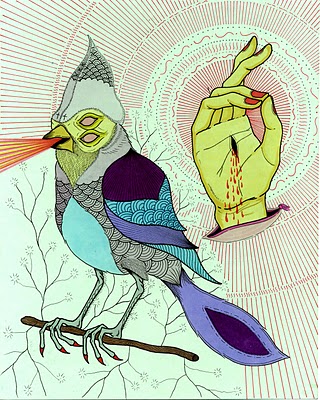
I really enjoy the graphic-tattooesque language of David M. Cook, especially on this piece that touches on religious iconography of the wound. 


Talking of his recent bird series: “I find the birds living in a new world of pattern and color, and they have taken on more religious iconography (another reappearing theme in my work) with the idea of killing dreams - The priests and bishops of this world trying to hold back the thoughts and ideas of the non-believers of their world, using mind-control, and often times death, to make their point.” David Cook.
 
The stigmatized hand in the background of this image is coming out of an open slit, which, judging by it's clitorial protuberance, is very much a vagina. I love the two small crosses on the bird's head, and the aureola type pattern emanating from the hand.


Tuesday, 18 June 2013

Witchcraft and Dissection


I went to a talk today titled Dissection and Witchcraft: Images of Corpses in Early Modern Art, by Constanza Isaza Martinez, which was based on her MA dissertation (History of Art, Courtauld Institute), at the Last Tuesday Society, part of a series of lectures organised by Morbid Anatomy.

Last time I heard about the Last Tuesday Society was admiring a beautifully crafted flyer for one of their famous parties, and besides throwing unique quirky parties, they are an organisation "devoted to exploring and furthering the esoteric, literary and artistic aspects of life in London and beyond", and they have the most amazing taxidermy-fanatic shop (11 Mare Street).

I have also come across Morbid Anatomy before, a blog and library based in Brooklyn, New York, who exist to survey 'the interstices of art and medicine, death and culture'. Sharing their love for skeletons, and corpses across the animal kingdom, these two uncanny venues have come together to delight us with a series of lectures and workshops throughout June and July, check their websites for more info.

So there I was, in the back room of the shop, still recovering from marvellous and monstrous sights such as a two-headed bat, a monkey-mermaid and a winged rodent.

Constanza's lecture was unique and fascinating in combining two realms that share a predilection for the body: witchcraft and anatomy. She discussed ways in which both the anatomist and the witch use the body, body parts and fluids, to exert their power. Similarly, they access the insides to search for ointments, particular organs or excretions to create their concoctions. Yet their status and representation could not be furthest apart, precisely because anatomists wanted to disassociate themselves from any occult practices, and wanted to present their practice as a new mission exclusively driven by the discovery of knowledge and truth, and completely unrelated to morbid curiosity.

All this talk was illustrated by historical prints of witches and anatomical illustrations, including the work of Vesalius and Alfred Durer and Hans Baldung. I truly enjoyed the lecture, which I found touched on a matter that has not been researched enough, and which my own research is concerned with.

Witches in a Cellar, Jacob de Gheyn II.

Sunday, 16 June 2013

Zero: Embodying the Blues

Earlier this month I went to see Zero, a performance by Clod Ensemble fusing dance, visual theatre and live music. The trailer reminded me somehow of the intro for the series True Blood. (Georges Bataille's dream series.)


It was all about the music, and the performers where dressed in suits and evening dresses, emphasising gender roles, swapping them, sometimes. The live music seemed to infuse the bodies of the dancers, to follow more scripted dances, contort like predating animals, act scenes of a silent play or become characters of human tragedy. A voice in the background which I placed in between a police interrogation and an American talk show, provided snapshots of deeply personal stories, of loss, suffering and love.

Perhaps there is a link between vampires, blues and human tragedy. Perhaps it's through tragedy that our animal instincts take over and bring chaos to ordered life, when men and women, dressed acceptably to go to church, can overlook civilised norms to crawl and bite. Some of the moves, some of the scenes in Zero, also reminded me of Riccardo Buscarini's Athletes, when there is silence, and a group of individuals exchange gazes that tell a whole story that we know nothing about. And sometimes they move together, others they isolate one, creating a prey.

Susan Aldworth: Printmaking and Anatomy in the search for Self


Susan Aldworth's work is currently on show at the National Portrait Gallery, until the 1st of September 2013. I am interested in her work because she works primarily with printmaking processes, the 3 pieces on show being portraits consisting of 9 monotypes; and with medical imagery, in this case with historical and modern scans of the human body. The sitters are people with epilepsy, a condition that links with the artists' search for ways to visualise the self. She has worked before with people with Alzheimer and Schizophrenia, and her current practice focuses on the gap between the physical materiality of the brain, and the interior sense of subjectivity.

My favourite piece is Elizabeth, 2012, whom Susan portrayed with an image of her face located in her lower abdomen, due to the woman's deep concerns about having a baby. A very interesting move, changing the commonly accepted seat of identity from the brain to the uterus. Elizabeth refused to take the drugs that controlled her epileptic attacks due to their impact on pregnancy, and with this risked her life. One could say thus, that her strong yearning for being a mother is effectively reflected in the portrait, where her face, her identity, lies within her womb.


I attended In Conversation: The Portrait Anatomised, on the 6th of June 2013, where a neuropsychologist, the artist, and Max (one of the sitters) came together. Most of the conversation turned around the difficulties of grasping the self, and the gap between the physical brain and consciousness. Susan's use of medical imagery is a turn in comparison to the tradition of portraiture hosted at the gallery, medicine portrays the inside in a literal and 'truthful' way. Furthermore, medical imaging captures a fragment and perhaps depicts a more suiting vision of a changing, fractured and elusive self? In comparison to traditional portraiture that seems to idealise subjectivity, elevating it to the status of 'essence', immutable and immortalized in the process of representation, almost assuming the existence of the soul.

I described medical images as 'truthful' because I think this notion of verisimilitude is problematic, the self is something we have a sense of, but that by definition cannot be seen, therefore what we see in medical images is not it, but it's as close as we can get to having a visual token of what it's like, where it inhabits. Following scientific discourse, we are not used to believing in things that we cannot see, we deem they do not exist, thinking that the other alternative, the soul, lies in the realm of religion. However, just because science cannot provide us an image of it, it does not mean the self does not exist, and it does not mean it is necessarily the soul.

We exist in the minds of others that know us (who know more of, or differently, about us than we do), and our unconscious also exists, the even more elusive version of our subjectivity. We are too used to equating seeing with believing, to equating what we think with what we are, and to looking for the truth by removing the skin, as if it stood for the fake appearance concealing the ultimate reality. We learned the story of the Incredulity of St Thomas all too well, and forgot it was a story.

 The Incredulity of St Thomas, Caravaggio.
 
 
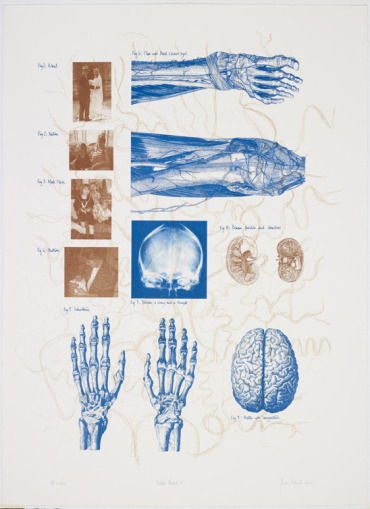
These are two lithographs from 2012 by Susan Aldworth, were she explores anatomically unorthodox representations of the body:
 
 Nature Nurture 2
 
 Reassembling the Self 4
 
 
Also on show now is Transience, a solo exhibition of Susan Alworth's work at the GV art Gallery, which I am looking forward to visiting.

Anatomical Wax Works

Eleanor Crook is a wax model artist that has done work for medical museums such as the Gordon Museum of Pathology and the Royal College of Surgeons, has a background in sculpture and fine art (Central Saint Martins and Royal Academy) and whose practice bridges art and science, using the fascinating technique of wax modelling. I would like to show images of a recent piece titled Death Seals Our Long Work of Thoughts, and a video in which we can see her working on a pathological model:


(Two images above) Death Seals Our Long Work of Thoughts, Eleanor Crook, 2013


She's quite unique in her specialisation, involvement with museums, as well as producing work of what would fall under an artistic nature. I find it very interesting how the materials and technique she has chosen to master, have beautifully inscribed her in the history of anatomical model making, linking her work to La Specola's museum specimens, for instance, the classic 18th century Italian models, which she even mentions in the video as an important influence.
 
And how a technique -wax modelling- having it's own cultural history, connotations, particular aesthetic and technical nature, can be further developed by a contemporary artist, employing this charged language to produce works that are relevant today, yet acknowledge our cultural history.
 
I guess this is how I feel about printmaking too, possessing intrinsic meaning, that I strive to discover and unleash, finding a logical and creative marriage between form and content.
 
Prosopology of the Dead, Eleanor Crook.
 
 
Prosopology of Death, is another piece by Eleanor Crook refering to death, and what I find so successful is the fact that the technique speaks of death too, so she uses this language to her advantage in shaping her ideas. Wax refers to death in many ways, from the anatomical models of disease, to it's use in death masks, and it's physical similarity to skin, which has made it a preferred material for realistic life-like representations of the body throughout history-which inevitably remind us of corpses. Following this trail of thought, go to an earlier post I did on wax. 


Monday, 29 April 2013

3-4 April SPILL festival of Performance 2013

I have already spoken about Jamie Lewis Hadley and Empress Stah, I would also like to highlight three other pieces from the SPILL festival of performance, 3-14 April 2013 in London.


Julie Vulcan's I Stand In, gave anonymous bodies a cleansing ceremony, to reflect upon global human tragedy and it's representation in the media, offering an alternative paused, silent, dignified treatment of the body. Each person is accepted by the host, to lie on a table, oil spread over their skin, a thin white sheet then soaks into them, and is hung on a washing line. Like white linen hanging to dry on two ropes, this is what she keeps of her repeated ritual. It reminded me of embalming and mourning for the dead, I think it shared similarities with this in it's caring and valuing of the body.


Heather Cassils' Becoming An Image was a one-off, unique visual experience. Naked muscles of a torso, what appears to be a wrestler, bouncing off the ground and circling around it's contender: a solid cube of hard clay. We can hear the heavy breathing, the punching, kicking, all their body used to collapse against the block, gasping, short noises, grunts, the fight goes on for about half an hour. But we can't see, everything is pitch black, and following the fighter going in circles, is a photographer, who shoots his flash and momentarily we saw, a silhouette of the man, woman? frozen in mid air as they throw themselves against the matter. The flash keeps going repeatedly, so we can see, so little, so briefly, it's on the edge of vision.

Then they leave the space, and slowly a dim light lites the arena, and the block appears with all the marks, bent out of it's rigid shape, completely mishaped, reflecting the strikes of the wrestler's anatomy.


I really liked the beginning of Season Butler's The Woman Who Walks On Knives, where she stands before a wooden table, paciently scraping a dead fish with a knive, taking it's scales off and putting them onto a pile on the side. This scales will travel far. She then undresses to put on some flippers, and tape her legs together bottom to top, puts a blonde wig on, oils her torso and throws on herself the scales. She is like The Little Sea-Maid of Hans Christian Anderson's tale, which inpired this piece. She will travel across the vast room, taking, aided with tweezers, a scale of her skin at a time, swinging her arm in a swimming stroke for each scale. Beautiful.
 
She then reaches a small stage, with an empty plastic fish tank, and attempts to sing, under the water, or drown her self. We fear for her, but she seems determined to go under the water. She finally cuts her legs open and leaves.


Sunday, 28 April 2013

Empress Stah in Space


Another mind-blowing performance in the SPILL festival, where Empress Stah, dressed with intergalactic second skin clothes (or none at all) contorts gracefully her body across the stage, blow-up stars below. Great acrobatics. The control she has over her body movements, despite the massive heels, of every part of her body, including her powerful gripping vagina muscles.

Her costumes, helmet, masks, heels, light devices are amazing. The slight clumsiness and awkardness of a robotic pokemon-power ranger on heels is overcomed by her pristine, decisive moves, and her authenticity. Everything is part of the Stah outerworld.

The peak of the piece was her use of her vaginal orifice creatively in the performance. Her white suit had a small red-pink opening, like a belly button made of cloth, which drew our atenttion to her parts, as she spread her legs and bended her body into forms. It was later revealed infront of our bewildered eyes that this gave access to her powerful vaginal muscles, which she used to hold a pen-like device to write onto a touch-screen, and later on, to hold a torch that shot a striking red beam of light which shone through a smoke filled stage, combining her twists and turns with a beautiful light show!

Empress Stah is an Aerial artist and neo-cabaret performer, this performance is "part of an ongoing project with a long-term ambition; to create a performance in outer space (...) Set on the plane of immanence, the show's concepts have been transcribed through trance and writing sessions between Empress Stah and seminal artist Ron Athey, which took place at Bentwaters in Suffolk, the site of the biggest purpoted UFO/Military incident in Europe." (SPILL 2013 catalog)

Jamie Lewis Hadley's Analogue to a Blunt Trauma


The fisrt piece I saw from SPILL festival of performance this year, was Jamie Lewis Hadley's Analogue to a blunt trauma, where the central theme, in my view, was the medical and violent connotations of the substance of blood. Carrying a golden gun, dressed with black boots and fingerless leather gloves, a man walks into the space, a white dimly lit room with a sofa. He lies there, and a woman walks in with a medical suitcase, dressed as a professional, yet not exactly like a doctor. She takes different devices out of her case and checks his blood pressure, to then begin a blood extraction. Soft spoken, she checks how he's feeling, though we can't hear the exact words, they have small chat, exchange a few smiles. The bag rests on the floor beside them, slowly filling up with the warm liquid from inside him.

Once it's full, the doctor walks behind the sofa, further back into the room, and proceeds to hang it from two wires, so it stands at eye level, suspended. She leaves.

The golden gun is resting before the sofa, to one side, it has been since he placed it there before he lied down. It seems a reminder of who he is, like a broken soldier whose wounds are being taken care of. He soon stands up and another man enters the space to hand him a new gun, this one is black and real; aiming at his own hung blood, he shoots.

Like shooting oneself, only through a medical device that isolates that living tissue, packaged, held together by plastic. This valuable liquid donated, sacrificed, in a literal way. Seems to have as little sense as men fighting and pouring each other's blood for whatever the reasons. Is it part of the initiation ritual of manhood? Get a gun, shed some blood, then you gain a certain status, matching with the boots and the leather gloves.


Jamie Lewis Hadley, former professional wrestler, is a solo live art performer that explores blood, deterioration, pain and violence. He is currently concerned with performing medicine and the history of bloodletting.

Jamie explains that his use of blood "comes from a frustration that I am unable to donate blood because I have had sex with a man ‘in the last 12 months’. Secondly, I believe a wider audience can engage with performance work that uses blood when medical equipment and professionals are used to extract and exhibit the blood." He also hopes that the topical use of a live firearm in the piece will highlight and raise questions around this current social and political issue. (Attitude.co.uk)

Sunday, 25 November 2012

Birthing and Breastfeeding Dolls


These Canadian handcrafted fabric dolls have the special property of being able to give birth and breastfeed their textile babies! They are called Mamamor, which in Spanish would mean mother (mama) and love (amor). Under swollen fabric sleep their offspring until they come out, attached with their umbilical cord and their mouths made with a press stud that clips straight onto the doll's nipple for breastfeeding. Genius.


Monday, 19 November 2012

Jean Paul Gaultier: Fabric Skin


Jean Paul Gaultier's anatomy inspired creations (above) and his skin dress designed for Almodovar's film The Skin I Live In (below).

Human Butchery


Unusual... to say the least. I could also say morbid, weird, freaky and- in my view- extremely interesting! Apparently there was a stall in Smithfield market selling chunks of human meat- or so they looked like. Fresh and well-preserved, a feast for the eyes of the anatomist!
According to the press release, “members of the public will be invited to sample and purchase a dizzying array of edible human limbs including hands, feet and a human head”. Other treats include Peppered Human & Lemon Sausages and J’avo-Caught Human Thigh Steaks.

“All proceeds from the sale of the meat will be donated to the Limbless Association, which provides information and support to the limb-loss community.”

These tasteless and wonderfully excentric stall was open 28-29 September 2012.
Check the website!

Saturday, 27 October 2012

The White Lodge and the Black Lodge


The White Cabinet (2006) and Anatomica (2007), Lisa Nilsson

I have selected my two favourite boxes from Lisa Nilsson's series titled Relics & Specimens. These are The White Cabinet and Anatomica. The series explores the value of collectable and found objects and blurs the distinctions between collectable, scientific specimen and holly relic. It delves into three areas that infuse objects with value: the private sphere, the scientific and the religious.


(Detail of Anatomica and The White Cabinet)

The White Cabinet reminds me of pharmacology and sterilized glass cabinets found in apothecaries or clinical environments whereas Anatomica brings sex and death into a silk dark secretive closet. For me they represent the rational, antiseptic sphere of a mind obsessed with order and control and it's nightmare: the repulsive body it inhabits, ruled by animalistic impulses, lust, gluttony and brutality.

 
Diseased flesh, decay, body parts, guts, stitched skin, a fetus and allusions to the female body (the marble head, the hourglass shape, the red circle-perhaps a womb, an ovule?) kept inside an erotic small vault both alluring and threatening to the male scientific world. A clean environment of compartmentalised solutions displayed in clear glass. Light radiates carefully arranged series of items, a manual of labels and definitions should accompany such array.
 

I adore... Lisa Nilsson's Paper Flesh Slicing


Angelico (detail) 2012, Lisa Nilsson

Lisa Nilsson has produced some exquisitely detailed anatomy themed paper work, imitating the scientific method of slicing bodies with delicate paper crafted pieces framed in precious shrine-like boxes. I absolutely love the contrast of anatomical crude sliced meat and her delicate work, and the combination of the scientific and religious. These are anatomical three dimensional illustrations, presented in the language of holly, cherished objects: the wooden tryptics, the guilded edges of old books, the soft velvet padded boxes, the contemplative and time-consuming process. These old  technique, quilling was "first practiced by Renaissance nuns and monks who are said to have made artistic use of the gilded edges of worn out bibles." (Lisa Nilsson)

Head and Torso, 2010, Lisa Nilsson

"I employ a device of making all of the bones in my work from the gilded edges of old books. I do this for aesthetic reasons as well as a means of pulling the pieces away from the world of scientific specimens and a bit more in the direction of religious reliquaries." Lisa Nilsson.
Praying Hands, 2012, Lisa Nilsson
   
The religious and anatomical keep coming together in unexpected ways... the preserved soul-less sliced human meat segments, the embelished saintly remains in reliquaries, the golden adorned Bible pages, the meticolous devoted craft of monks and nuns. The violent vision of the insides decorated and embellished, elevated above its earthly and mortal phisicality, infused with spiritual value.


Friday, 7 September 2012

Vagina Shrine


How amazing is that?! A vagina-shaped shrine in some remote Spanish town, named Olmeda de Cobeta, in Guadalajara. Thank you Blanca Quintas for this reference her uncle gave her, which reminded them of my work! Absolutely love it.

With the little female figure, the virgin Mary of course, peeping out of the opening among some flowers. Interesting how the vagina-shaped hollow and herself come together in this wonderful coincidence when she is the one who birthed Jesus through immaculate conception, a very particular vagina in deed...


Saturday, 1 September 2012

Layers of Skin


When I saw this ad for Dermablend, featuring 'zombie boy', it reminded me of the type of performance work I do, specially when he rubs out his fake skin starting with a hole in the middle of his chest...

Very inspiring.

The Artist is Present


I went to watch this documentary at the Tate tanks, their new space for performance art, and was mind blown by Marina's piece at the MoMA. During her retrospective there, she underwent (seems an appropiate word to describe it) a performance where she would sit and look at a member of the audience at a time. There was a delineated space, in it two chairs and a table, in one of the chairs Marina Abramovic would sit waiting for someone else to sit in front of her, and then would look straight into their eyes, for as long as they decided to stay. What is most astounding about this piece, is the fact that she did this for the whole 3 months that the exhibition was on, everyday, since the opening until the closing of the museum, 6 days a week.

She gazed down and would stare at you when you sat, giving you her presence, an individualized look, and experience of being in a shared moment, here and now. Dedicating three months of her life doing practically 'nothing' yet so much. Siting still, simple, powerful.

Such a primal human connection, given full atenttion and intensified. A body and mind in full presence, encountered by an'other'.

Extremely reactionary for our western standards of behaviour, this woman stands simply staring back at you, offering herself, her time, to this excruciatingly long and painful task. 'Doing nothing' elevated to the category of art, framed in a prestigious institution.

I like... Carole Hensher's anatomy work!


I really like these works on textiles by Carole Hensher, the one above is titled Anatomy Lesson and is lithography on fabric. I thought I'd seen it somewhere else before, and then I remembered, she was in last year's BITE exhibition (below). Applying printmaking to other surfaces opens up alot of possibilities, and when it comes to anatomical imagery, printing it onto fabric which covers the skin, reflecting on what lies under, makes us more aware of the fact that we could peel off and have a look within. Reminds me of 'ecorches', self-peeling anatomical models that pose and show their insides in renaissance illustrations.


Tuesday, 6 December 2011

Covet me, Care for Me


Covet me, Care for Me was a durational performance on the 26th November, at the Wellcome Collection by Sheila Ghelani, part of Clod Ensemble's Anatomy Season of Performing Medicine. Delicate glass hearts containing nurse watches where arranged and displayed on the floor, offerings from the artist, giving heart-shaped pieces away to be broken and taken away, to be coveted by others.


Brittle replicas of her own heart maybe, or emotionally charged hosts of cherised belongings perhaps. Beautiful shells designed to receive violence, to crash under the hands of those who want to posses their insides. Clocks worn by nurses, ticking beside their heart while they perform their duty, to take care, to nurse, to love-albeit medically- the patients. Bodies in need of repair, in need of delicate hands to take care of them, to ammend them. Nurses that give, dedicated in the art of healing. Hearts that tick and sometimes need repair, hearts that ache, broken hearts.


Cherised objects, offerings, from me to you. Does something belonging to us become a body part? If we loose it, we physically feel the absence of a phantom limb. Sometimes there is prayer, to feel better, to fill better-the emptiness. Sometimes we regret what we gave away, others we believe it is a necessary sacrifice to bring what is longed to us, swaping fate with God. Breaking a little bit, showing our wound to invoque spiritual healing.